If Your Data Isn't AI-Ready, Neither Is Your Initiative

Data readiness — not data existence — determines whether an AI initiative ships. Five practices that turn an existing data environment into one AI systems can actually use.
Read more →How we replaced a failing SQL agent and gave Pharma Market Access teams insights across 90+ jurisdictions in seconds.
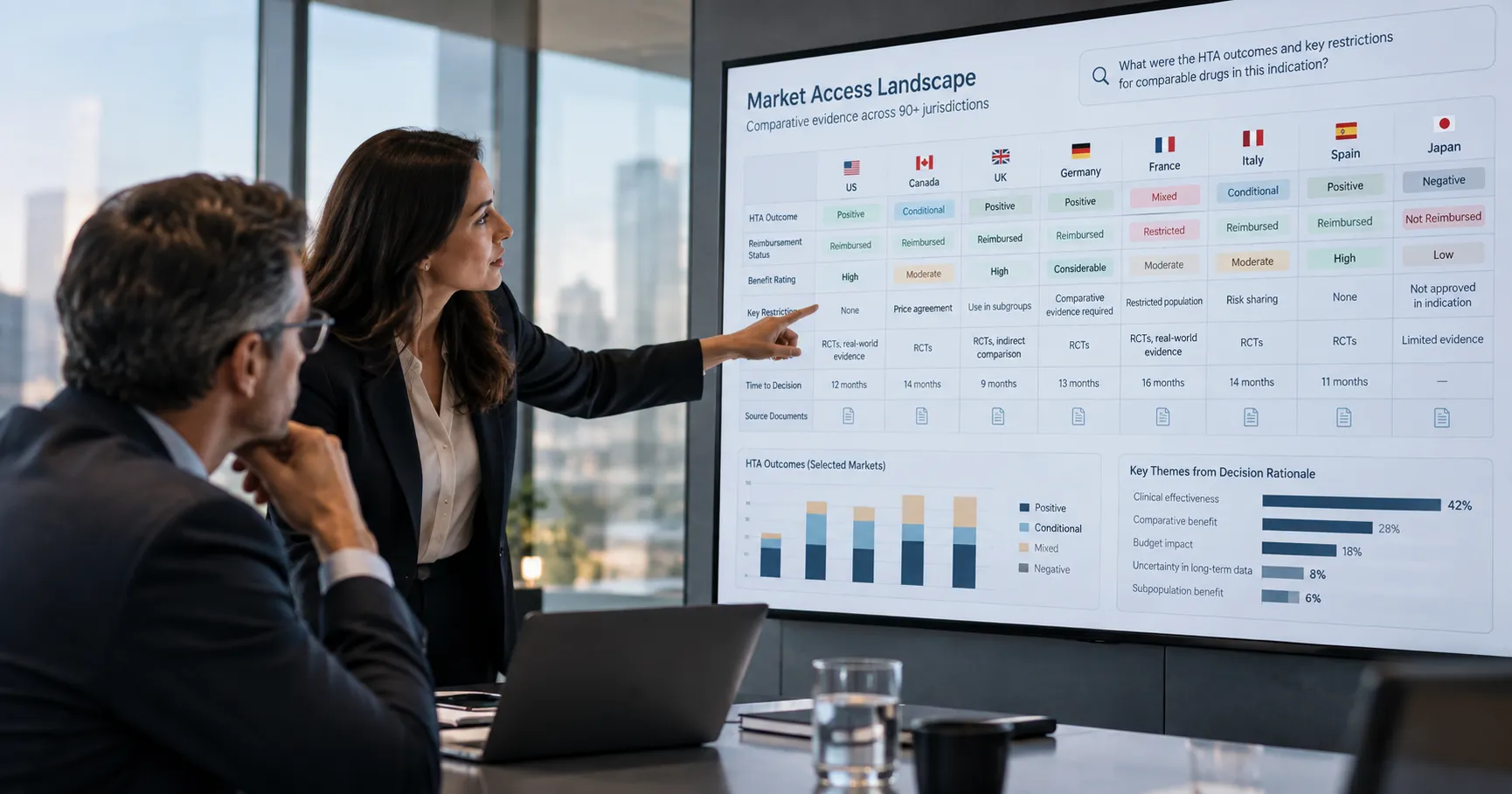

A life sciences data company gives pharmaceutical market access teams regulatory, HTA, and reimbursement data across dozens of markets. Users could find any record. They could not get an answer to a question. Every landscape question broke down into filters, exports, and spreadsheets, or a wait of days for an expert's report, and precedent fell through the gaps.
The company had already tried an AI agent. An external vendor spent months and a significant budget on it, and the agent covered a narrow slice of the data and failed in real use. Engineering leadership decided to replace it, and this time to test the architecture before funding the build.
Prosperaize built a metadata layer on the domain knowledge, reorganized the data into domain views, and validated one agent architecture before the company committed to the build. The platform now answers questions across 300+ columns in under 60 seconds. Regular use among platform users rose from 10% to 55%.
The company's platform serves market access teams at global pharmaceutical companies. It holds regulatory decisions, health technology assessments, and reimbursement outcomes across national and regional jurisdictions, down to the evidence behind each decision and the documents where the reasoning lives.
A team preparing a launch needs precedent from it: what each HTA body decided for comparable drugs, on which evidence, with which restrictions, and why. That precedent shapes the reimbursement strategy and the launch sequence. Misreading one market can cost a resubmission cycle.
Find records. Not answer questions. A filter takes one condition per field. A landscape question carries many at once and often needs a computation across the results. "What share of decisions in this indication carried restrictions, by country, and is it trending?" No filter computes that. And from any result there was no way to go deeper: which trials this decision was assessed against, which approval preceded it, which reimbursement conditions followed, why it went negative. Each was a new search.
So every real question became filter, export, deduplicate, cross-tabulate, read the documents. Precedent dropped out at each step. The most-asked questions had already been turned into templates. That was the signal: users needed templates because they could not compose the questions themselves.
When users could not get there, they asked the company's in-house experts, who asked data engineers, who wrote queries that came back for validation. Days per question, occupying the two groups the company could least spare.
So the company invested in an SQL agent. An external vendor built it over several months, with ongoing support from the internal team. It arrived as a narrow first version: a single view with 10 columns, basic SQL only. It had no structured outputs, no guardrails, and no separation between domain logic and agent logic, so it could not grow into the questions users were asking.
It had also shaped the platform around itself. API contracts, frontend components, and services were all written against its limits. Replacing it meant weeks of extra engineering to remove it from every system it touched.
A failed AI agent in production shapes API contracts, frontend expectations, and service architecture around its limitations. Removing it means paying once to build it, once to work around it, and once more to take it out.
Prosperaize replaced the first agent with an intelligence layer the company owns, one that handles the full complexity of market access data across every jurisdiction in the dataset. It rests on four capabilities.
A structured knowledge layer: column descriptions, business-context annotations, country-specific constraints, value-range definitions. It made the database understandable to an AI agent. This was the least visible work in the engagement and everything else depended on it. We kept refining it after the first version, as edge cases surfaced.
Twelve purpose-built database views spanning 300+ columns, pre-encoding the critical JOINs, country-specific business logic, and semantic groupings. Instead of asking the agent to work out the database, we reorganized the database so the agent could use it.
A LangGraph-based agent with query validation, deterministic SQL, complexity classification, multi-turn conversation handling, and strict output guardrails. Every query component is validated before execution. The same question produces the same SQL every time. The guardrails also cover what the data cannot say.
Document summarization with parallel extraction and majority voting, and an API that makes the agent available to other teams and other agents. Both sit on a composable architecture designed for expansion from the start.
The client knew what they needed. Not an AI strategy, a diagnosis. They had an agent in production that was not working, and the first question was whether it could be saved. So the engagement started where a failing system enters the AI Asset Development Lifecycle: at diagnosis. Each step below names the lifecycle stage it maps to.
AI Reliability & Optimization, entry point
Engineering leadership brought us in to find out whether the existing agent could be fixed. Over two weeks we ran workshops with them and the internal team who had been supporting the agent, and we inspected the codebase.
The business bottleneck was obvious. The data foundation was the finding. The data had never been described for a machine reader. Jurisdiction-specific constraints lived with the domain experts, not in anything an agent could read. No agent could have worked against the data in that state, whoever built it.
The codebase confirmed the rest. Its structure could not carry the questions users needed answered, so improving it was not an option. It had to be replaced. Engineering leadership accepted that verdict, and the cost of it, on the evidence.
AI Opportunity & Readiness Assessment, data readiness only
A rebuild normally loops back to the first stage for strategy: which use case, what return, in what order. The company skipped that part by agreement. The use case was already proven by demand, and they wanted an implementation, not a plan. What could not be skipped was the data. We spent two weeks building the first metadata layer with their domain experts: column descriptions, business-context annotations, jurisdiction-specific constraints, value ranges. Every later capability depended on it.
Enterprise text-to-SQL against data of this complexity was unsolved at the time. So the company funded a ten-week validation phase before committing to a build, longer than a standard feasibility sprint because the problem had no known solution, and on the understanding that the first architecture might not pass.
We built the first approach against the normalized schema and asked the agent to learn the JOINs across ten-plus tables. Through several iterations the same constraint held: even simple questions needed multi-table JOINs, latency was unacceptable, and outputs were not deterministic. We gave one documented no-go, with the evidence behind it. The company accepted it without pushback, because the phase had been designed to produce exactly that kind of answer.
The pivot followed from the evidence. The agent should not need to understand the database's internal structure. We created domain-organized views that pre-encoded the hard parts, and the agent's job changed from "work out the database" to "query the right view with the right filters." That architecture worked in testing against the real data, not only in a demo.
Alongside the architecture, we ran a short economic analysis of what each agent invocation would cost at expected query volumes. The result was a cost per query that made the agent a sensible business model for the platform, not only a working feature. With both answers in hand, the company funded the build.
A ten-week validation phase produced one documented no-go, one working architecture, and a cost per query the business could carry. The first attempt produced the negative answer alone, after months of work and a full budget spent, in production.
With a validated architecture, we moved to production engineering in LangGraph with standards set from the start: query validation, deterministic SQL, complexity classification, conversation tracking, document intelligence, domain logic stored as data rather than code, strict output guardrails, and a composable service architecture.
Removing the old agent's integrations added weeks of our engineering time to work around architectural debt that should never have existed.
AI Reliability & Optimization, ongoing
After launch, regular use among platform users grew from 10% to 55%. Nothing was mandated. The growth came from capabilities we added: multi-turn conversation, document summarization, and an API, which we exposed in a single week because the architecture was composable.
Once an AI asset is live, we look for three things. Questions users already ask that the system cannot answer yet. Teams, products, and agents that could use the same capability. Places where the answer could arrive inside the work users already do. Each builds on the knowledge layer that already exists, so every addition costs less than the last and is worth more.
The company entered the lifecycle at this stage with an agent that was failing. They are at this stage again with one that keeps gaining value, which is what the stage is for.
Enterprise text-to-SQL is a domain engineering problem, not a prompt engineering problem. The pivot that worked was not a better model or a better prompt. It was reorganizing the data so the agent no longer had to solve problems that humans also struggle with.
If your users export to spreadsheets or rely on templates for the questions that matter, the data is there and the access layer is the gap. A metadata foundation and domain-organized views make it answerable without simplifying it.
The sunk cost is the agent plus the architecture that grew around it. A structured assessment determines whether to fix, replace, or remove it before the integration debt grows further.
When analysts, consultants, or domain specialists spend days assembling data before they can start their real work, a production-grade query layer returns that time to the work that needs them.
Most AI features ship and stagnate. Composable architecture and domain logic stored as data let each capability build on the last, at falling cost and rising value.
If you already run an AI agent that is not delivering, an AI Reliability & Optimization engagement diagnoses whether the problem is the architecture, the data, or both, and sets the path to fix or replace it. If you run a data product and have not built an agent yet, an AI Opportunity & Readiness Assessment shows whether your data can support one and what has to be built first.
Data readiness — not data existence — determines whether an AI initiative ships. Five practices that turn an existing data environment into one AI systems can actually use.
Read more →
AI assets demand a breadth of expertise that no single role, team, or department was ever designed to carry. Here's what actually goes wrong and why.
Read more →
Most AI investment failures are decided in the first two weeks. This is how you ensure those two weeks are used wisely.
Read more →API contracts calcify around it. Frontend components lock to its limitations. Services inherit its quirks. The largest sunk cost is the architectural debt shaping every system it touches.
If your AI investment is already exposed, a Prosperity Audit diagnoses whether the problem is architectural, data-related, or both — before the integration tax compounds further.
Get in touch