
Give every employee an expert to ask
Create an AI assistant that answers questions using your company’s documents, policies, and internal knowledge—so employees spend less time searching and more time getting work done.
Your most valuable knowledge is also your most fragile. It walks out the door when a senior hire leaves, hides in inboxes and wikis nobody searches, and slows every new joiner for months. Most companies treat that as a documentation problem. It isn’t — it’s an asset that either compounds or decays.
Left alone, it decays: the same questions get re-answered, the same mistakes get re-made, and the cost of a single departure is measured in lost context you can’t buy back. Knowledge Intelligence turns that risk into a business asset—knowledge that’s always available, always searchable, and no longer dependent on a handful of people.
This connects to risk (key-person dependency), cost (onboarding + hours lost to searching), and velocity (decisions made now, not after a meeting to find the person who knows).
Create an AI assistant that answers questions using your company’s documents, policies, and internal knowledge—so employees spend less time searching and more time getting work done.

Give every new hire immediate access to the knowledge they need, reducing onboarding time without constantly relying on senior colleagues.
'%3e%3crect%20x='20.7771'%20y='53.946'%20width='4'%20height='4'%20rx='2'%20fill='%23AFC3F8'/%3e%3c/g%3e%3cg%20filter='url(%23filter1_i_6041_344)'%3e%3crect%20x='20.7771'%20y='78.946'%20width='4'%20height='4'%20rx='2'%20fill='%23AFC3F8'/%3e%3c/g%3e%3cg%20filter='url(%23filter2_i_6041_344)'%3e%3crect%20x='113.777'%20y='53.946'%20width='4'%20height='4'%20rx='2'%20fill='%23AFC3F8'/%3e%3c/g%3e%3cg%20filter='url(%23filter3_i_6041_344)'%3e%3crect%20x='113.777'%20y='78.946'%20width='4'%20height='4'%20rx='2'%20fill='%23AFC3F8'/%3e%3c/g%3e%3cpath%20d='M74.2708%2076.1874V68.5208H47.4375V76.1874H57.0208V82.8958H47.4375V90.5624H74.2708V82.8958H64.6875V76.1874H74.2708Z'%20stroke='%2301203D'%20stroke-width='2'%20stroke-linecap='round'%20stroke-linejoin='round'/%3e%3cpath%20d='M74.2708%2076.1875L90.5625%2055.1042V47.4375H63.7292L47.4375%2068.5208'%20stroke='%2301203D'%20stroke-width='2'%20stroke-linecap='round'%20stroke-linejoin='round'/%3e%3cpath%20d='M74.2708%2090.5625L90.5624%2069.4792V65.6133L82.3993%2065.6689'%20stroke='%2301203D'%20stroke-width='2'%20stroke-linecap='round'%20stroke-linejoin='round'/%3e%3cdefs%3e%3cfilter%20id='filter0_i_6041_344'%20x='20.7771'%20y='53.946'%20width='4'%20height='5'%20filterUnits='userSpaceOnUse'%20color-interpolation-filters='sRGB'%3e%3cfeFlood%20flood-opacity='0'%20result='BackgroundImageFix'/%3e%3cfeBlend%20mode='normal'%20in='SourceGraphic'%20in2='BackgroundImageFix'%20result='shape'/%3e%3cfeColorMatrix%20in='SourceAlpha'%20type='matrix'%20values='0%200%200%200%200%200%200%200%200%200%200%200%200%200%200%200%200%200%20127%200'%20result='hardAlpha'/%3e%3cfeOffset%20dy='1'/%3e%3cfeGaussianBlur%20stdDeviation='1'/%3e%3cfeComposite%20in2='hardAlpha'%20operator='arithmetic'%20k2='-1'%20k3='1'/%3e%3cfeColorMatrix%20type='matrix'%20values='0%200%200%200%200.054902%200%200%200%200%200.247059%200%200%200%200%200.494118%200%200%200%200.08%200'/%3e%3cfeBlend%20mode='normal'%20in2='shape'%20result='effect1_innerShadow_6041_344'/%3e%3c/filter%3e%3cfilter%20id='filter1_i_6041_344'%20x='20.7771'%20y='78.946'%20width='4'%20height='5'%20filterUnits='userSpaceOnUse'%20color-interpolation-filters='sRGB'%3e%3cfeFlood%20flood-opacity='0'%20result='BackgroundImageFix'/%3e%3cfeBlend%20mode='normal'%20in='SourceGraphic'%20in2='BackgroundImageFix'%20result='shape'/%3e%3cfeColorMatrix%20in='SourceAlpha'%20type='matrix'%20values='0%200%200%200%200%200%200%200%200%200%200%200%200%200%200%200%200%200%20127%200'%20result='hardAlpha'/%3e%3cfeOffset%20dy='1'/%3e%3cfeGaussianBlur%20stdDeviation='1'/%3e%3cfeComposite%20in2='hardAlpha'%20operator='arithmetic'%20k2='-1'%20k3='1'/%3e%3cfeColorMatrix%20type='matrix'%20values='0%200%200%200%200.054902%200%200%200%200%200.247059%200%200%200%200%200.494118%200%200%200%200.08%200'/%3e%3cfeBlend%20mode='normal'%20in2='shape'%20result='effect1_innerShadow_6041_344'/%3e%3c/filter%3e%3cfilter%20id='filter2_i_6041_344'%20x='113.777'%20y='53.946'%20width='4'%20height='5'%20filterUnits='userSpaceOnUse'%20color-interpolation-filters='sRGB'%3e%3cfeFlood%20flood-opacity='0'%20result='BackgroundImageFix'/%3e%3cfeBlend%20mode='normal'%20in='SourceGraphic'%20in2='BackgroundImageFix'%20result='shape'/%3e%3cfeColorMatrix%20in='SourceAlpha'%20type='matrix'%20values='0%200%200%200%200%200%200%200%200%200%200%200%200%200%200%200%200%200%20127%200'%20result='hardAlpha'/%3e%3cfeOffset%20dy='1'/%3e%3cfeGaussianBlur%20stdDeviation='1'/%3e%3cfeComposite%20in2='hardAlpha'%20operator='arithmetic'%20k2='-1'%20k3='1'/%3e%3cfeColorMatrix%20type='matrix'%20values='0%200%200%200%200.054902%200%200%200%200%200.247059%200%200%200%200%200.494118%200%200%200%200.08%200'/%3e%3cfeBlend%20mode='normal'%20in2='shape'%20result='effect1_innerShadow_6041_344'/%3e%3c/filter%3e%3cfilter%20id='filter3_i_6041_344'%20x='113.777'%20y='78.946'%20width='4'%20height='5'%20filterUnits='userSpaceOnUse'%20color-interpolation-filters='sRGB'%3e%3cfeFlood%20flood-opacity='0'%20result='BackgroundImageFix'/%3e%3cfeBlend%20mode='normal'%20in='SourceGraphic'%20in2='BackgroundImageFix'%20result='shape'/%3e%3cfeColorMatrix%20in='SourceAlpha'%20type='matrix'%20values='0%200%200%200%200%200%200%200%200%200%200%200%200%200%200%200%200%200%20127%200'%20result='hardAlpha'/%3e%3cfeOffset%20dy='1'/%3e%3cfeGaussianBlur%20stdDeviation='1'/%3e%3cfeComposite%20in2='hardAlpha'%20operator='arithmetic'%20k2='-1'%20k3='1'/%3e%3cfeColorMatrix%20type='matrix'%20values='0%200%200%200%200.054902%200%200%200%200%200.247059%200%200%200%200%200.494118%200%200%200%200.08%200'/%3e%3cfeBlend%20mode='normal'%20in2='shape'%20result='effect1_innerShadow_6041_344'/%3e%3c/filter%3e%3c/defs%3e%3c/svg%3e)
Capture the experience and judgment of key people before they leave, retire, or change roles—so valuable knowledge stays with the business.

Give employees instant access to the right procedures, policies, and past decisions exactly when they need them—not after three Slack messages and two meetings.
And the measurable outcomes underneath it: faster answers, lower onboarding cost, and reduced key-person risk. Not a demo on sample data; a system your people use daily.
You own all of it — the models, the pipelines, the knowledge layer. No black box, no lock-in, no dependency on us to keep it running.
The first real work is deciding what knowledge is worth capturing and what to let go; a smaller, well-organized knowledge base beats a huge collection of outdated documents every time. Teams also discover that “we have it documented” and “people can find and trust it” are very different things — and the gap is exactly where the value is.

Compounding
Value
Is your knowledge AI-ready? (sources, quality, access, sensitivity)
Read MoreProve it answers correctly and trustworthily on your material before the build.
Read MoreProduction system wired into your sources and tools.
Read MoreKeep answers accurate as your knowledge changes.
Read More
Data readiness — not data existence — determines whether an AI initiative ships. Five practices that turn an existing data environment into one AI systems can actually use.
Read more →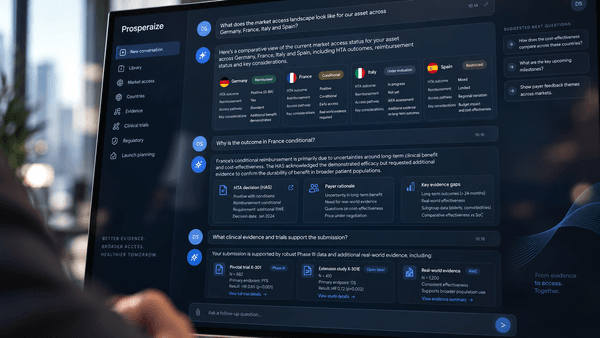
How a live AI system on a pharmaceutical market access platform was rebuilt on its own knowledge foundation, and single answers became a working dialogue with the data.
Read more →
Judge it the way you'd judge a machine. There are four questions, and your answers decide whether you're buying an asset or a write-off.
Read more →It’s an AI system that gives employees instant answers using your company’s own documents, policies, and expertise—not information from the public internet.
ChatGPT is trained on public information. Your business runs on internal knowledge, processes, and documents. A Knowledge Intelligence system answers using your company’s own information, while respecting permissions and showing where every answer comes from.
That’s exactly what we validate before anything goes into production. The system is tested using your own documents, and every answer links back to its original source so employees can verify important information.
Whatever holds your knowledge — docs, wikis, tickets, policies, transcripts. Part of the early work is deciding which sources are worth including and getting them into shape; we help you determine that.
You own it outright — models, pipelines, and the knowledge layer. No recurring license, no lock-in.
You’ll know whether it’s feasible and worth it within the 30-day validation sprint — on your real material — before committing to the full build.
What happens when your most experienced employee goes on leave—or leaves for good? How much time does your team spend searching for answers that already exist somewhere? How much knowledge disappears simply because nobody knows where to find it?
Those are exactly the questions worth answering before another year of undocumented expertise quietly walks out the door.
If you’re asking them internally, you’re probably at the right stage to talk.
