
Entirely new user workflows
Enable customers to achieve outcomes your product has never been capable of delivering—not simply complete existing tasks more efficiently.
Bolting AI onto your product isn't innovation. It's a wrapper for the changelog. Real innovation isn't measured by the number of AI features on your roadmap. It's measured by the new outcomes your product makes possible.
The capabilities that create the greatest competitive advantage are rarely the ones customers request—they're the ones customers never imagined were possible until they experienced them. The best AI feature is usually the one your users can't request, because they don't know it's possible yet.
Connects to revenue (new value, expansion) and differentiation (capability competitors lack).
Enable customers to achieve outcomes your product has never been capable of delivering—not simply complete existing tasks more efficiently.

Anticipate what customers need before they ask, reducing effort while creating an experience competitors struggle to replicate.

Transform your proprietary data into recommendations, predictions, or decisions customers couldn't produce on their own.

Move beyond helping users make decisions to completing reliable work on their behalf—where automation creates trust instead of additional oversight.
Built to last in production. A reason customers choose your product over the one that just added a chat box.
You own all of it — models, pipelines, integrations. No black box, no lock-in.
It's usually hidden in plain sight until someone looks. And predicting what users need beats asking them: surveys capture what people can articulate, not the capability they didn't know to want.

Compounding
Value
Which new capability is worth building, and does your data/workflow support it.
Read MoreProve it works and that users value it before the build.
Read MoreProduction-grade, integrated into the product, owned by you.
Read MoreKeep it performing as usage and data evolve.
Read More
Most AI investment failures are decided in the first two weeks. This is how you ensure those two weeks are used wisely.
Read more →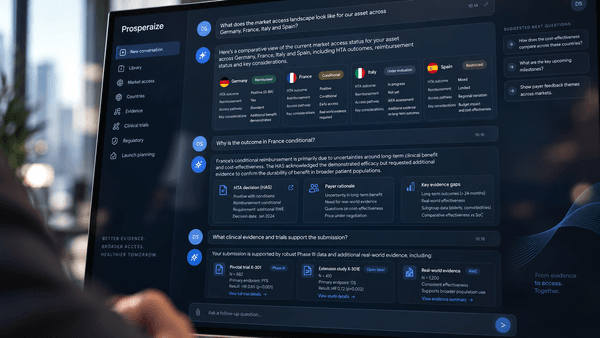
How a live AI system on a pharmaceutical market access platform was rebuilt on its own knowledge foundation, and single answers became a working dialogue with the data.
Read more →
Judge it the way you'd judge a machine. There are four questions, and your answers decide whether you're buying an asset or a write-off.
Read more →Real innovation changes what customers are able to achieve—not simply how they interact with your product. We evaluate whether an AI capability creates new customer outcomes, changes buying behaviour, or strengthens your competitive position before recommending investment.
Customers are experts in their problems, not in the capabilities AI makes possible. The goal isn't to ignore customer feedback—it's to understand the underlying problem well enough to identify solutions customers couldn't have requested themselves.
AI enables products to predict, reason, recommend, generate, and execute in ways traditional software couldn't. The opportunity isn't simply adding those capabilities—it's identifying where they create genuinely new value for your customers.
No. But the most defensible ones usually do. AI models are becoming increasingly accessible, making proprietary data, unique workflows, and accumulated domain knowledge the real sources of long-term differentiation. During the Readiness Assessment, we evaluate whether your business already has an advantage worth building around—or whether the opportunity is likely to be easy for competitors to replicate.
Not every workflow should be automated. Some AI capabilities are most valuable as decision support, while others can safely execute work on behalf of users. The decision depends on business risk, reliability requirements, and the cost of getting it wrong. We validate those conditions during Feasibility & ROI Validation before recommending autonomous execution.
Yes — models, pipelines, integrations. No lock-in.
We validate both feasibility and user value within the 30-day sprint.
What should your product enable customers to do that isn't possible today? Which customer problem could AI fundamentally solve instead of simply improving? And which of those opportunities is significant enough to redefine how your product competes?
Those are exactly the questions worth answering before committing another sprint to AI.
If you're asking them internally, you're probably at the right stage to talk.
