
Plan with greater confidence
Predict future demand, revenue, or workload so you can make better staffing, inventory, budgeting, and investment decisions.
More dashboards don’t make better decisions. Dashboards report; people decide — and they’re drowning in charts while the actual call still rides on gut and gut’s slower cousin, the status meeting. The bottleneck was never a shortage of data; it’s the gap between data and a decision someone will stand behind.
Decision Intelligence closes that gap: it predicts the outcome, ranks the options, and recommends the move — so the decision happens now, with evidence, instead of next quarter, on a hunch.
Connects to velocity (decide faster), revenue/cost (better calls on pricing, demand, allocation), and risk (fewer expensive guesses).
Predict future demand, revenue, or workload so you can make better staffing, inventory, budgeting, and investment decisions.

Understand how customers are likely to respond before changing prices, helping you grow revenue without relying on guesswork.

Give employees clear recommendations about the highest-value action for each customer, opportunity, or situation.

Compare different business scenarios and understand the likely consequences before investing time, money, or resources.

Identify changing patterns early enough to act before they affect revenue, operations, or customer satisfaction.
Predictions tied to specific actions, not charts left for interpretation. A working decision asset wired to your data, owned by you, that leaders actually use.
You own all of it — models, pipelines, the decision logic. No black box, no lock-in.
A prediction that nobody acts on creates no business value. The value shows up when the recommendation lands in the workflow where the decision is actually made, with enough explanation that the decider trusts it.

Compounding
Value
Which decision is worth improving, and can your data predict it.
Read MoreProve the prediction is accurate and actionable before the build.
Read MoreWired into where the decision is made, owned by you.
Read MoreKeep predictions accurate as conditions drift.
Read More
Most AI investment failures are decided in the first two weeks. This is how you ensure those two weeks are used wisely.
Read more →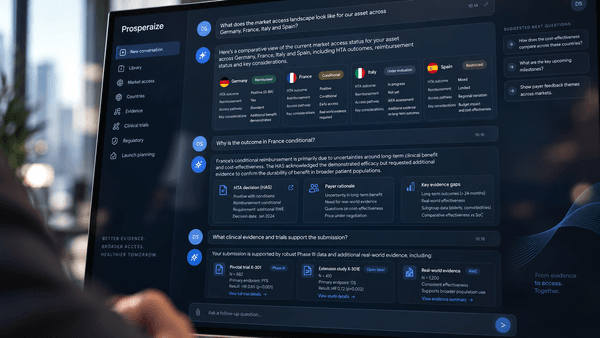
How a live AI system on a pharmaceutical market access platform was rebuilt on its own knowledge foundation, and single answers became a working dialogue with the data.
Read more →
Judge it the way you'd judge a machine. There are four questions, and your answers decide whether you're buying an asset or a write-off.
Read more →Dashboards tell you what happened. Decision Intelligence helps you decide what to do next by predicting likely outcomes and recommending actions—not just reporting numbers.
No. The goal isn’t perfect data—it’s reliable enough data to support better decisions. Part of our assessment is determining whether your existing information is sufficient or what needs to improve first.
We measure accuracy on your real data before any build, and monitor it in production. If they don’t improve decision-making, you’ll know before investing in a full implementation.
Yes — models, pipelines, logic. No lock-in.
Within our 30-day validation sprint, you’ll know whether better predictions can create measurable business value before committing to a larger investment.
Which decisions have the biggest impact on revenue, cost, or risk? How much of those decisions still depends on instinct rather than evidence? If you could improve just one decision in your business, which one would change the outcome the most?
Those are exactly the questions worth answering before investing in another reporting tool.
If you’re asking them internally, you’re probably at the right stage to talk.
