
Stay compliant as your AI evolves
Maintain ongoing conformity with regulations such as the EU AI Act as your models, data, business processes, and regulatory requirements change—without treating compliance as a one-time project.
Compliant at launch isn't compliant forever. The risk you scored before go-live is already out of date — the model changed, the data shifted, the regulation moved. Governance done once, as a box-tick, decays the moment the system keeps running.
And an audit trail you assemble after the incident isn't an audit trail; it's a reconstruction nobody believes. For AI in a regulated or trust-sensitive domain, governance is a continuous posture, not a launch gate — the EU AI Act won't wait for your next sprint.
Connects to risk (regulatory exposure, incidents), trust (defensible decisions), and cost (the price of a finding you didn't see coming).
Maintain ongoing conformity with regulations such as the EU AI Act as your models, data, business processes, and regulatory requirements change—without treating compliance as a one-time project.

Continuously reassess operational, regulatory, and business risks as your AI asset evolves, ensuring decisions are based on today's reality rather than yesterday's assumptions.

Maintain up-to-date documentation, audit trails, and explainability records that support internal governance, customer assurance, and regulatory requests whenever they're needed.

Monitor production AI for emerging security threats, misuse, bias, data leakage, and other governance issues before they result in incidents, regulatory findings, or reputational damage.
Fewer governance gaps, reduced regulatory exposure, faster audit readiness — and a framework that supports growth rather than slowing it down.
You own the governance framework, controls, documentation, monitoring, and supporting processes. No black box. No lock-in.
Models, data, and regulations all move. The cheap version is continuous; the expensive version is discovering the gap when someone's already asking for the records.
Governance, Risk & Compliance lives at node ④ — AI Reliability & Optimization.

Compounding
Value
Ready for AI - and for what, exactly?
Read MoreIs this worth the investment?
Read MoreYou know it works. Now build it properly.
Read MoreKeep it performing and grow the ROI. Or fix what's failing.
Read MoreCurrent conformity, risk posture, and documentation gaps.
Risk re-scoring, audit trails, and safety monitoring into the running system.
Keep it current as the system and the rules change.

Before you fund it, score your project on these ten dimensions. Or accept the downside.
Read more →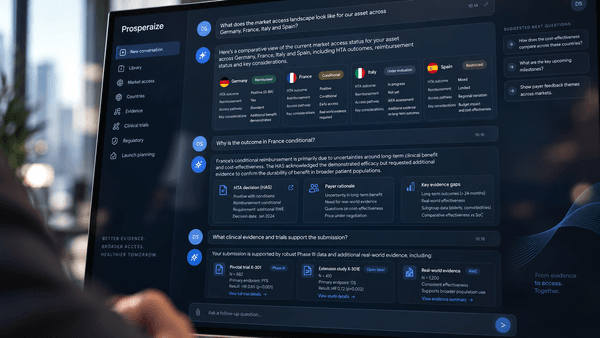
How a live AI system on a pharmaceutical market access platform was rebuilt on its own knowledge foundation, and single answers became a working dialogue with the data.
Read more →
Judge it the way you'd judge a machine. There are four questions, and your answers decide whether you're buying an asset or a write-off.
Read more →Compliance isn't something you achieve once—it's something you maintain. As models, data, regulations, and business processes evolve, your governance framework must evolve with them. Prosperaize continuously monitors those changes, helping ensure your AI asset remains compliant long after it enters production.
An AI Act compliance audit provides a point-in-time assessment of your current level of conformity. Ongoing governance ensures that conformity is maintained as your AI system evolves. One tells you where you stand today. The other helps you remain compliant tomorrow.
Effective AI governance extends beyond regulatory documentation. It includes risk management, decision accountability, auditability, security, documentation, monitoring, model changes, data changes, and the processes that ensure AI continues operating responsibly throughout its lifecycle.
Governance should evolve whenever your AI asset evolves. New models, changing data, expanding use cases, regulatory updates, or business changes can all affect your risk profile. Continuous governance replaces periodic catch-up exercises with an ongoing management process.
Absolutely. Many organizations inherit AI systems without the governance processes needed to manage them effectively. We assess the current state, identify governance gaps, and implement the controls, documentation, and monitoring required to manage the AI asset throughout its operational life.
Not necessarily. Building an internal governance capability requires expertise across AI, regulation, risk management, and operational processes. Many organizations choose to outsource ongoing governance while retaining full ownership of their AI assets, documentation, and decision-making.
No organization can predict every regulatory update, but they can build governance processes that adapt. Prosperaize focuses on creating governance frameworks that evolve alongside regulations, reducing the effort required to remain compliant as legal requirements change.
Yes — prompt injection, data leakage, and bias monitoring sit under risk here.
Yes — controls, documentation, monitoring. No lock-in.
How prepared is your organization to demonstrate ongoing conformity—not just historical compliance? Where are governance gaps most likely to emerge as your AI continues to evolve? And what would it take to manage compliance as an operational capability rather than an occasional project?
Those are exactly the questions worth answering before the next audit, customer review, or regulatory request.
If you're asking them internally, you're probably at the right stage to talk.
