
Process high volumes of documents
Automate the repetitive work behind invoices, contracts, claims, applications, and other documents that slow your operations and consume valuable employee time.
The costliest work is rarely the work that gets automated first. Automation starts where it’s easy, not where it hurts — teams digitize a tidy process and leave the expensive, messy one untouched because it’s hard. Meanwhile a handful of workflows quietly eat most of your effort and budget.
Cutting cost with AI means finding those, proving AI can handle them, and leaving the rest alone. Done right, it’s the most direct line from AI to your P&L.
Connects to cost (lower run-rate), velocity (faster throughput), and capacity (people freed for higher-value work).
Automate the repetitive work behind invoices, contracts, claims, applications, and other documents that slow your operations and consume valuable employee time.

Automate the routine operational tasks that keep finance, HR, operations, and administration busy—freeing people for work that actually requires human judgment.

Automate the operational work behind customer requests so your teams can deliver faster without sacrificing consistency or quality.

Automatically route requests, documents, or decisions to the right people, reducing delays without losing oversight.

Connect multiple tasks into one intelligent workflow that can complete work from start to finish—with people involved only where their judgment adds value.
With the savings quantified before you commit, and the validated workflows built into your existing operations so AI becomes part of how work gets done.
You own all of it — code, models, integrations. No black box, no lock-in.
Find those, and the automation case writes itself; spread effort evenly across everything, and it doesn’t. The other recurring lesson: full autonomy is rarely the right first step — assisted/partial automation often captures most of the value at a fraction of the risk.

Compounding
Value
Process-mining the work to find the expensive workflows worth automating.
Read MoreProve automation works and pays on your real process before the build.
Read MoreBuilt into your existing systems, owned by you.
Read MoreKeep it running and improving as volume scales.
Read More
Before you fund it, score your project on these ten dimensions. Or accept the downside.
Read more →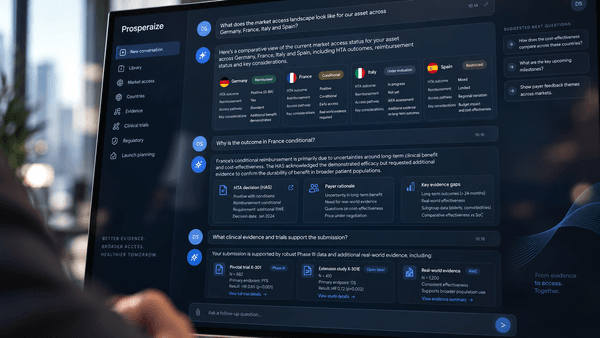
How a live AI system on a pharmaceutical market access platform was rebuilt on its own knowledge foundation, and single answers became a working dialogue with the data.
Read more →
Judge it the way you'd judge a machine. There are four questions, and your answers decide whether you're buying an asset or a write-off.
Read more →Start with the work that is repetitive, expensive, and happens frequently. The goal isn’t to automate everything—it’s to identify the few processes where automation creates the biggest business impact.
Usually not. Many companies achieve most of the value by automating repetitive steps while keeping people involved where experience or judgment still matters.
Sometimes—but only after we’ve proven it’s reliable enough. In most cases, AI supports people first before gradually taking on more responsibility as confidence grows.
You own it outright — code, models, integrations. No lock-in.
Before implementation, we measure how much time, money, and effort the process consumes today. After deployment, we measure the same metrics again so the results are based on evidence—not assumptions.
Where is your team spending time that customers never see? Which manual process has quietly become part of the cost of doing business? If you removed it tomorrow, how much capacity would your business gain?
Those are exactly the questions worth answering before investing in automation.
If you’re asking them internally, you’re probably at the right stage to talk.
