
Respond to competitive AI moves
Decide whether to match, leapfrog, or deliberately ignore a competitor's AI feature. Not every competitive move deserves a response.
Shipping a me-too AI feature is how you lose to the company that built the right one. When competitors launch AI, it's easy to assume you need the same capability. But copying features rarely creates competitive advantage—it usually creates another race nobody wins.
Sustainable differentiation comes from solving customer problems in ways only your product can, using knowledge, workflows, and data your competitors don't have.
Foundation models are increasingly available to everyone. Competitive advantage comes from how intelligently you apply it.
Decide whether to match, leapfrog, or deliberately ignore a competitor's AI feature. Not every competitive move deserves a response.

Transform data only your business possesses into customer value competitors can't easily reproduce.

Use AI to strengthen the reasons customers choose—and continue paying for—your product instead of competing on price alone.

Embed AI so deeply into customer workflows that replacing your product becomes increasingly difficult—not because switching is hard, but because your product delivers more value every day.
Every implementation is built on assets competitors can't easily replicate, integrated into real customer workflows, and measured by its commercial impact.
You own all of it — models, data pipelines, integrations. No black box, no lock-in.
It's the proprietary data and the depth of workflow integration around it. And the me-too feature rushed out to "keep up" usually costs more in eroded trust than the gap it was meant to close.

Compounding
Value
Where your real edge is (data, workflow), and which response is worth making.
Read MoreProve it's both buildable and defensible before you commit.
Read MoreProduction-grade, integrated where it's hard to copy.
Read MoreKeep the edge sharp as competitors react.
Read More
AI assets demand a breadth of expertise that no single role, team, or department was ever designed to carry. Here's what actually goes wrong and why.
Read more →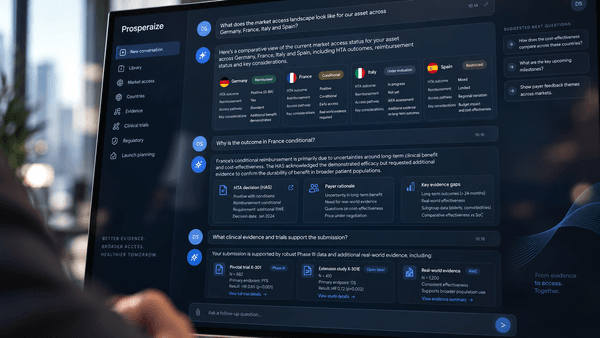
How a live AI system on a pharmaceutical market access platform was rebuilt on its own knowledge foundation, and single answers became a working dialogue with the data.
Read more →
Judge it the way you'd judge a machine. There are four questions, and your answers decide whether you're buying an asset or a write-off.
Read more →Through what the model can't be: your proprietary data, your workflow depth, your integration. We build the advantage where it's hard to copy, not on the model layer where it isn't.
Not necessarily. Sometimes feature parity is essential. Sometimes it's a distraction. Before investing, we assess whether matching creates customer value, whether a better alternative exists, or whether your advantage lies somewhere entirely different.
Competitive advantage comes from customer relationships, proprietary knowledge, workflow integration, trust, and accumulated data. AI amplifies those assets—it rarely replaces them.
Customers don't compare features in isolation. They compare which product helps them achieve their goals more effectively. The question isn't whether AI makes your product smarter. It's whether it makes your product the better choice.
Yes — models, data, integrations. No lock-in.
The strongest AI investments become more valuable as customers use them because they continuously learn from proprietary data and become embedded in daily workflows. We evaluate not only whether a capability creates value today, but whether that advantage is likely to strengthen—or erode—as the market evolves.
We validate the right response in the 30-day sprint, so speed doesn't cost you a feature that breaks in production.
Should you match your competitor's latest AI feature—or build something they can't? Where does your product already have an advantage AI could amplify? And if every competitor had access to the same AI models tomorrow, why would customers still choose you?
Those are exactly the questions worth answering before committing another sprint to AI.
If you're asking them internally, you're probably at the right stage to talk.
