
Premium AI tiers & packaging
Design AI capabilities that customers see as premium enough to justify upgrading, not features that quietly become expected in the base plan.
Adding AI doesn't raise what people will pay. Solving the job does. Most "AI tiers" are a discount nobody asked for — a feature bolted to the pricing page that costs real money on every call and lifts revenue on none of them.
Monetizing AI isn't primarily a technology challenge—it's a product strategy challenge. The real question isn't how to build the capability. It's which capability customers value enough to pay for, how to package it, and how to protect margins as usage grows.
Connects to revenue (ARPU, expansion) and margin (pricing that beats cost-to-serve).
Design AI capabilities that customers see as premium enough to justify upgrading, not features that quietly become expected in the base plan.

Design a pricing model that aligns customer value with your AI costs—without creating bill shock or penalizing your highest-value accounts.

Use AI to increase revenue from existing customers by creating capabilities worth upgrading for—not simply features that increase product complexity.

Identify which AI capabilities deserve to stand on their own commercially instead of disappearing into the core subscription.

A premium analytics/insights tier or API inside your product.
Pricing and packaging that adds margin, not just activity — built and instrumented so you can see the revenue, not assume it.
You own all of it — the feature, the metering, the models. No black box, no lock-in.
And usage-based pricing that looks "fair" on a slide can quietly punish your highest-volume accounts — the ones you least want to lose — unless it's modeled against real usage first.

Compounding
Value
Which AI value is monetizable, and what your users will actually pay for.
Read MoreProve the pricing and unit economics before you build.
Read MoreThe feature + metering, wired into your product and billing.
Read MoreKeep margin healthy as usage scales.
Read More
Most AI investment failures are decided in the first two weeks. This is how you ensure those two weeks are used wisely.
Read more →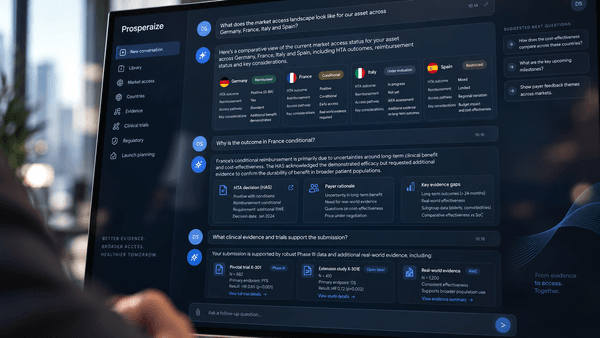
How a live AI system on a pharmaceutical market access platform was rebuilt on its own knowledge foundation, and single answers became a working dialogue with the data.
Read more →
Judge it the way you'd judge a machine. There are four questions, and your answers decide whether you're buying an asset or a write-off.
Read more →Customers rarely pay for AI itself—they pay for a better outcome. The real question isn't whether users think the feature is interesting, but whether it creates enough value to change buying behaviour. Before recommending implementation, we validate willingness-to-pay, commercial value, and whether the feature strengthens your product enough to justify a premium.
It depends on the role AI plays in your product. Some AI capabilities increase the value of your core offering and belong in every plan. Others create enough additional value to justify premium tiers, add-ons, or usage-based pricing. The right decision depends on customer expectations, competitive positioning, and long-term economics—not development cost. This is what we assess.
There isn't a single pricing model that works for every product. Successful companies price AI based on the value customers receive, the ongoing cost of delivering that value, and how the capability fits into the overall product strategy. The goal isn't simply recovering inference costs—it's creating a pricing model that customers understand and your margins can sustain.
This is one of the biggest commercial risks in AI product development. Competitive pressure often encourages companies to add AI simply because others have. Before investing, it's important to distinguish between AI that customers see as basic product hygiene and AI that creates enough additional value to justify paying more.
Depends on your usage distribution. Usage pricing aligns cost and revenue but can spook heavy accounts; we model it on your real data before you commit.
Profitability depends on far more than development cost. We evaluate customer willingness-to-pay, expected adoption, operating costs, competitive positioning, and long-term unit economics before recommending implementation. The goal isn't simply launching an AI feature—it's building one that improves both customer value and business performance.
Most successful AI products combine existing foundation models with custom product logic, workflows, and proprietary business knowledge. The competitive advantage rarely comes from training your own model—it comes from solving customer problems better than anyone else. The right architecture depends on your product, not industry trends.
No — that's a standalone product (Build a New AI Asset). This is monetizing AI inside the product you already ship.
Yes — feature, metering, models. No lock-in.
Which AI capability would customers genuinely pay more for? How would it change your pricing, margins, or competitive position? And how much engineering effort should you invest before knowing those answers?
Those are exactly the questions worth answering before committing another sprint to AI.
If you're asking them internally, you're probably at the right stage to talk.
