
Specific idea, unvalidated
You have a concrete AI initiative in mind but haven’t tested whether it actually works.
You have a concrete AI initiative in mind but haven’t tested whether it actually works.

You’ve seen promising AI demos but aren’t sure they hold under production conditions.

You’re ready to invest, but need hard proof before committing significant budget and resources.

Risk, cost, and ROI must stand up to scrutiny from the board or C-suite.
Every AI initiative carries the same hidden risk: it can ace the demo and fall apart in production. The architecture looks sound. The demo wows the room. The budget gets approved. Then it meets messy data, edge cases nobody tested, and users who don’t follow the happy path — and it starts failing in ways the demo never showed. Usually after the money’s spent and the deadline is looming.
A real working piece of the system, built on your data and your systems. Not a mockup, not a demo. Proof of whether the solution works in your environment.
The real running costs: what it costs per transaction, per user, per month — and what you get back. The number your CFO will ask for.

A clear call — proceed, pivot, or stop — grounded in the prototype results, the cost analysis, and the risk picture. And when it’s “not yet”: exactly what would have to change, or be built first, to earn the go.

Every technical, operational, and compliance risk identified, rated by severity, and paired with a mitigation. No surprises waiting in production.
There’s no lock-in. If the sprint ends in a no-go, or you decide to take it elsewhere, you walk away with the validated plan, the go/no-go decision and its evidence, the risk analysis, and the ROI projections. Continue with us, hand it to another vendor, or build it in-house. The work is yours either way.
The path to production is clear and de-risked: you know what works, what it costs, what it returns and the known risks are named, mitigated, and priced in. The investment is validated before the big money moves. Or you walk away with the evidence, and, usually, the path that would turn it into a go. Either way, you know.

How we replaced a failing SQL agent and gave Pharma Market Access teams insights across 90+ jurisdictions in seconds.
Read more →
Most AI investment failures are decided in the first two weeks. This is how you ensure those two weeks are used wisely.
Read more →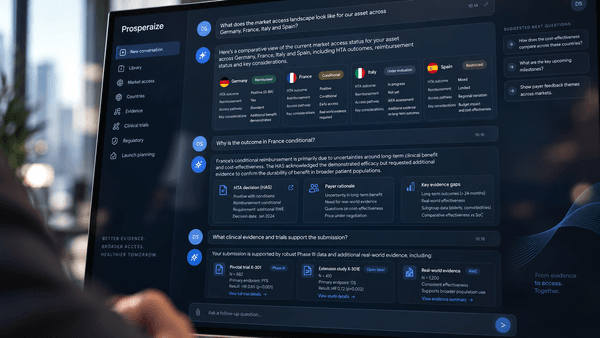
How a live AI system on a pharmaceutical market access platform was rebuilt on its own knowledge foundation, and single answers became a working dialogue with the data.
Read more →That’s exactly what the Feasibility & ROI Validation Sprint is designed to answer. In 30 days, we validate technical feasibility, expected business value, implementation risks, and ROI—before you commit to full-scale development.
Each sprint is fixed at 30 days and scoped to your specific initiative. Pricing depends on integration complexity, data availability, and the number of scenarios we evaluate. You’ll receive a fixed proposal after the initial conversation.
Most feasibility sprints are completed within 30 days. Long enough to evaluate the initiative on real data, short enough to avoid months of unnecessary development if the answer is no.
You’ve just avoided a far more expensive failure. And a no-go rarely arrives empty-handed. It usually comes with the prescription: what would have to change, or be built first, for the initiative to earn its go. A pattern we’ve seen: the no-go reveals a prerequisite system — and building it first doesn’t just clear the path, it increases the ROI the asset was supposed to deliver. You keep the prototype, the analysis, and the path. That’s a result, not a write-off.
Yes. We validate every initiative using your actual data, systems, and operational constraints. A prototype that only works on sample data hasn’t proven anything.
A vendor’s proof of concept is designed to sell their implementation. Our validation is designed to help you make the right investment decision—even if the conclusion is to postpone, redesign, or not build at all.
Yes. Having a promising idea doesn’t guarantee technical feasibility or business value. The sprint exists to confirm whether your proposed solution deserves a larger investment.
Yes. We evaluate whether the solution can perform reliably using your data, infrastructure, and operational requirements—not just in a controlled demonstration.
We evaluate implementation costs, operating costs, expected business impact, technical feasibility, and alternative solutions to estimate whether the investment is financially justified before development begins.
Not every problem requires custom development. As part of the sprint, we compare custom AI, commercial products, and non-AI alternatives to recommend the approach that creates the greatest long-term business value.
Our Feasibility & ROI Validation process is designed to answer the questions that matter before significant capital is committed. In 30 days, you’ll know whether to move forward with confidence, refine the opportunity, or walk away before unnecessary time and budget are spent.
Sometimes, one conversation is enough to understand which path you’re on.
