
Detect performance problems before customers notice them
Continuously monitor quality, reliability, cost, and system health so performance issues are identified internally—not through customer complaints.
Your AI was accurate at launch. That's not the same as reliable. Models evolve, data changes, customer behaviour shifts, and costs grow. Without continuous performance management, AI assets quietly lose accuracy, reliability, and business impact—often long before anyone notices.
The choice isn't whether your AI's performance moves; it's whether you see it move or your customers do. If you're not monitoring it, they're testing it for you — for free, and they remember the answer that was wrong.
Connects to risk (silent failure), trust (customer-facing quality), and cost (catching issues early vs. after the blow-up).
Continuously monitor quality, reliability, cost, and system health so performance issues are identified internally—not through customer complaints.

Identify when changing data, user behaviour, or model performance begins reducing accuracy so corrective action can be taken before business results suffer.

Maintain response times, availability, and service levels as usage grows and infrastructure changes.

Validate updates against production-quality benchmarks so every improvement actually improves business outcomes.
Faster issue detection, fewer customer-impacting failures, improved service consistency, and the metrics needed to continuously optimize quality and cost as your AI evolves.
You own all of it — the monitoring, evals, and dashboards. No black box, no lock-in.
The gap between "accurate in the demo" and "reliable in production" is exactly where trust is lost: a system that's right 95% of the time is remembered for the 5%.
Performance Assurance lives at node ④ — AI Reliability & Optimization.

Compounding
Value
Ready for AI - and for what, exactly?
Read MoreIs this worth the investment?
Read MoreYou know it works. Now build it properly.
Read MoreKeep it performing and grow the ROI. Or fix what's failing.
Read MoreWhat's actually happening in production (quality, drift, latency, cost).
Monitoring, alerting, and evals wired into your system.
Catch and correct degradation as conditions change.
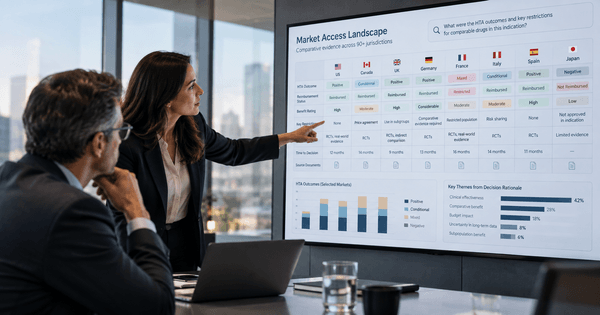
How we replaced a failing SQL agent and gave Pharma Market Access teams insights across 90+ jurisdictions in seconds.
Read more →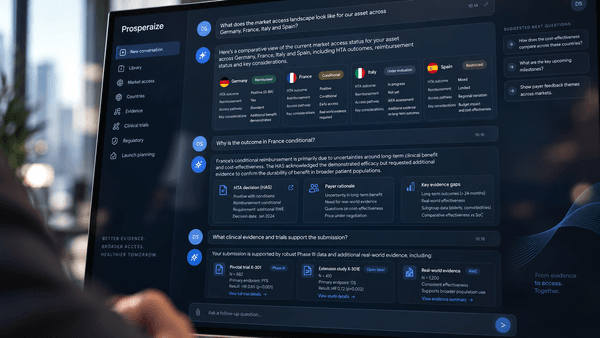
How a live AI system on a pharmaceutical market access platform was rebuilt on its own knowledge foundation, and single answers became a working dialogue with the data.
Read more →
Judge it the way you'd judge a machine. There are four questions, and your answers decide whether you're buying an asset or a write-off.
Read more →The only reliable way is to measure it continuously against the outcomes that matter to your business. AI systems don't usually fail overnight—they gradually drift as data, user behaviour, and operating conditions change. Prosperaize establishes the monitoring, evaluation, and performance baselines needed to detect those changes early, before they affect customers or business results.
Declining performance is rarely obvious until it starts affecting customer experience or downstream decisions. We continuously evaluate your AI against representative production scenarios, monitor quality trends over time, and identify the underlying cause—whether it's data drift, changing user behaviour, infrastructure issues, or model degradation. The objective isn't simply measuring performance; it's understanding why it's changing and what to do about it.
Availability is only one part of AI performance. Depending on your system, we typically monitor output quality, response accuracy, latency, cost, reliability, model drift, user behaviour, business KPIs, and the health of the supporting infrastructure. The goal isn't collecting more metrics—it's monitoring the indicators that directly influence business performance.
AI isn't software you deploy and forget. Every production AI asset should be reviewed continuously through automated monitoring, with deeper optimization driven by changes in customer behaviour, business priorities, technology, or operating costs. Our role is to ensure your AI evolves alongside your business rather than gradually becoming less valuable.
Absolutely. Many of our engagements begin with AI systems developed by internal teams or external vendors. We independently assess their current performance, establish observability where it's missing, and implement the processes needed to continuously improve reliability, efficiency, and business value—without requiring a complete rebuild.
Not necessarily. Building an internal AI operations capability requires highly specialized expertise that many organizations don't need full-time. Prosperaize provides that expertise as an extension of your team, giving you access to experienced AI engineers, proven methodologies, and continuous optimization without the cost and complexity of building the function internally.
If your monitoring tells you whether servers are running but not whether your AI is still delivering business value, it's incomplete. Effective AI performance management measures both technical health and business outcomes, allowing you to identify deterioration long before customers experience it.
Yes. Visibility is often the fastest path to optimization. Understanding where resources are consumed, where latency originates, and where quality exceeds—or falls short of—business requirements allows organizations to reduce unnecessary infrastructure costs while maintaining or improving customer outcomes.
Yes — monitoring, evals, dashboards. No lock-in.
How would you know if quality quietly declined? Would your team discover the issue—or your customers? And what would weeks of unnoticed degradation actually cost your business?
Those are exactly the questions worth answering before small performance issues become expensive operational problems.
If you're asking them internally, you're probably at the right stage to talk.
