
Your AI is live — but no longer performing as expected
Accuracy has drifted, costs have increased, latency has become a problem, or users are losing confidence. The system needs optimization before it loses more value.
Accuracy has drifted, costs have increased, latency has become a problem, or users are losing confidence. The system needs optimization before it loses more value.

The system delivers results, but no one is actively improving it, measuring new opportunities, or helping it create additional business value. AI assets should appreciate—not stand still.

Live for a year or more without an upgrade? Models got better and cheaper while your system stood still—you may be overpaying for underperformance with no visible symptom at all. Nobody has checked what a year of progress is worth on your numbers.
Whether it came from another vendor, an acquisition, or an internal team, you need an independent diagnosis before deciding what to optimize, rebuild, or retire.
Left alone, a deployed model slowly gets worse: the real world changes, your data changes with it, costs creep, and an edge case you never scoped starts failing in front of customers. By the time the numbers slip enough to notice, trust is already spent. And a system that shipped broken rarely fixes itself — it sits half-used while everyone argues about whose fault it is.
Treating AI as a one-time build is how something expensive becomes something expensive and useless.
If you want a hands-off “set it and forget it” model, we’re not the fit. AI in production needs an owner.
For a stalled or failing system: we find the root cause in the logs, data, and evals — then fix it, or tell you honestly when it needs rebuilding.

Accuracy, latency, cost-per-action, and drift watched continuously, so problems surface before they reach your users or your P&L.
Tuning and retraining to keep it working as things change, while keeping costs and risk in check.

Watching one system closely often reveals the next place AI can pay off — so each project makes the next one better. This is where Continuous Prosperity™ takes over.

Tracked against the baselines set at build, so the value is proven, not assumed.
You also keep everything — dashboards, eval suites, pipelines, playbooks.
This is an ongoing engagement, not a project with an exit deliverable — but everything stays yours: the dashboards, the eval suites, the retraining pipelines, the documented fixes. Stop whenever you like; you keep all of it, and your team can run it.
Stewardship rarely ends in a straight line — it feeds back into the lifecycle:
If the system needs rebuilding, we don’t patch forever. We loop back to AI Opportunity & Readiness Assessment (in Fit & Data Readiness mode — reassess the approach and data), re-validate, and rebuild it properly.
If monitoring surfaces a new opportunity, that starts a fresh asset under Continuous Prosperity™ — built cheaper on the foundation this one created.

AI assets demand a breadth of expertise that no single role, team, or department was ever designed to carry. Here's what actually goes wrong and why.
Read more →
How we replaced a failing SQL agent and gave Pharma Market Access teams insights across 90+ jurisdictions in seconds.
Read more →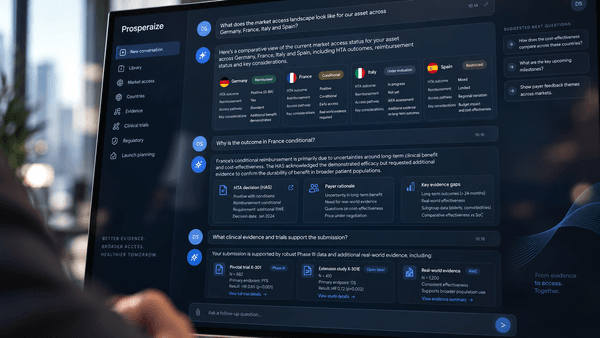
How a live AI system on a pharmaceutical market access platform was rebuilt on its own knowledge foundation, and single answers became a working dialogue with the data.
Read more →AI systems change over time. Data evolves, user behavior shifts, and business processes change. Without monitoring, evaluation, and continuous optimization, performance naturally degrades. Our job is to identify why it’s happening and restore performance.
We diagnose the system first. Sometimes targeted improvements are enough. Sometimes the architecture, integrations, or underlying assumptions need to be redesigned. We recommend the approach that creates the greatest long-term value—not the most billable work.
Yes. If development has stalled or the system never successfully reached production, we identify the root cause, simplify where necessary, and determine whether optimization or rebuilding is the fastest path forward.
Maintenance keeps a system running. Optimization improves how it performs. We continuously evaluate accuracy, reliability, cost, user adoption, and business impact so your AI keeps creating more value—not simply staying online.
Absolutely. Production AI shouldn’t stand still. We identify opportunities to improve performance, reduce operating costs, and uncover new ways your existing AI assets can create additional business value.
“Fine” against what? It’s fine against last year’s benchmark. Models have gotten better and cheaper since your system shipped — we check what current models and prices would do to your cost-per-action. Sometimes the answer is “leave it,” and then you know.
Yes. We frequently inherit AI systems built by internal teams or other vendors. We begin with an independent assessment of how the system actually performs in production before recommending optimization, rescue, or a complete rebuild.
We implement monitoring, evaluation, observability, and performance reporting to continuously measure system health, business impact, and model quality. That allows us to identify problems before users do.
Most clients work with us on a monthly retainer based on the number of AI systems under management, their complexity, and the level of support required. If you need help with a single underperforming system, we also offer fixed-scope diagnostic engagements.
We measure AI against the business outcomes it was designed to improve—not just technical metrics. That includes operational efficiency, cost savings, revenue impact, user adoption, and other KPIs that determine whether the investment is still creating value.
Like any strategic business asset, AI requires periodic review to ensure it continues delivering the value it was built to create. The question isn’t simply whether it’s working—it’s whether it’s still the right solution, still aligned with your business, and still producing the return your investment deserves.
One conversation can tell you whether your AI should be optimized, rescued, rebuilt, or simply left alone. That’s clarity worth having before you further invest time or money.
