
In-product fraud & abuse protection
Prevent malicious use before it affects your customers, your platform, or your reputation.
Safe AI isn't a cost on the roadmap. It's the reason the roadmap survives. Every AI capability makes a promise to your customers. Whether it helps them make decisions, generates content, or automates work, they'll judge it by one question: Can I trust it?
Products earn trust when they protect data, acknowledge uncertainty, fail safely, and behave consistently. That's not a constraint on innovation—it's what allows innovation to succeed in the real world.
Connects to risk (incidents, liability), trust (retention, brand), and compliance (the AI in your product, by design).
Prevent malicious use before it affects your customers, your platform, or your reputation.

Ensure AI-generated and user-generated content reflects the standards your customers expect.

Build transparency, auditability, and controls directly into the product so trust scales alongside adoption.

When AI isn't confident, it explains, asks, or hands off—instead of pretending to know.
Built with the guardrails, monitoring, and controls required to earn trust, support adoption, and operate in demanding environments.
You own all of it — models, guardrails, controls. No black box, no lock-in.
The system that knows its limits and hands off cleanly outperforms the more "capable" one that occasionally invents an answer with total confidence.

Compounding
Value
Where the trust/safety risk is, and what "safe enough to ship" means here.
Read MoreProve the guardrails hold on real, adversarial inputs before launch.
Read MoreSafety built into the feature, owned by you.
Read MoreMonitor safety in production; risks shift, so the guardrails do too.
Read More
How we replaced a failing SQL agent and gave Pharma Market Access teams insights across 90+ jurisdictions in seconds.
Read more →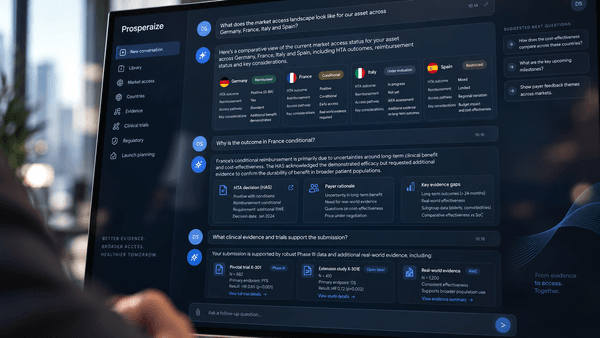
How a live AI system on a pharmaceutical market access platform was rebuilt on its own knowledge foundation, and single answers became a working dialogue with the data.
Read more →
Judge it the way you'd judge a machine. There are four questions, and your answers decide whether you're buying an asset or a write-off.
Read more →Compliance is about meeting legal obligations. Trust is about meeting customer expectations. An AI Act audit determines whether your AI conforms to the regulation. This service focuses on designing AI that behaves safely, protects users, and earns confidence in real-world use. The two complement each other, but they solve different business problems.
Not every AI capability carries the same level of risk. The appropriate safeguards depend on what the AI influences, the consequences of getting it wrong, and your customers' expectations. During Readiness we define what "safe enough to ship" means for your product.
Good guardrails don't reduce value—they protect it. The goal isn't restricting AI unnecessarily, but ensuring customers can rely on it in the moments that matter most.
No safeguard eliminates every risk, which is why trustworthy AI combines grounding, guardrails, monitoring, and safe-failure behaviour. We validate those controls during Feasibility & ROI Validation before they ever reach production.
Risk & Quality Intelligence uses AI to protect your business—detecting fraud, defects, operational risks, or quality issues before they become costly. Trust, Safety & Compliance protects your customers by ensuring the AI inside your product behaves safely, reliably, and responsibly. One improves your operations; the other improves your customer experience.
Yes — models, guardrails, controls. No lock-in.
Less than an incident does. Safety-by-design is what lets you ship at all in a serious market.
How much trust does your AI need to earn before customers depend on it? Where could a single failure undermine months of product adoption? And what safeguards belong in the product before—not after—you launch?
Those are exactly the questions worth answering before introducing AI into experiences your customers rely on.
If you're asking them internally, you're probably at the right stage to talk.
