
Scale customer operations
Help more customers without increasing the operational effort behind every account. The objective isn't replacing people—it's allowing the same team to create more customer value.
The cost of serving your next thousand customers shouldn't be linear — but for most products it is. Every new cohort adds support tickets, onboarding load, and manual ops, so growth quietly eats the margin it creates.
The right AI capabilities reduce repetitive effort, shorten onboarding, and help customers succeed without demanding more from your team. If AI reduces costs but makes the customer experience worse, you've simply delayed the cost of churn.
Connects to cost (cost-to-serve, margin), velocity (onboarding, throughput), and scale (growth without proportional headcount).
Help more customers without increasing the operational effort behind every account. The objective isn't replacing people—it's allowing the same team to create more customer value.

Help customers reach value sooner while reducing the manual effort required from your implementation and success teams.

Remove repetitive operational work that limits growth so your teams spend more time improving the product instead of running it.

Use AI to improve qualification, activation, and conversion so growth becomes more efficient—not simply more expensive.
Every implementation is tied to measurable improvements in operational efficiency, customer experience, or profitability—so growth creates stronger margins instead of additional operational burden.
You own all of it — models, integrations, automations. No black box, no lock-in.
The real win is usually the work you stop doing, not the people you remove: when AI takes the repetitive load, the same team serves far more customers at a higher standard.

Compounding
Value
Which cost-to-serve driver AI can break, and is your data/process ready.
Read MoreProve the cost and quality numbers on real volume before the build.
Read MoreWired into your product and ops, owned by you.
Read MoreHold quality and cost as you scale.
Read More
Before you fund it, score your project on these ten dimensions. Or accept the downside.
Read more →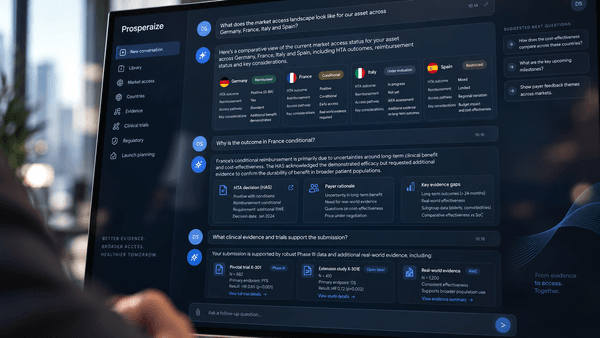
How a live AI system on a pharmaceutical market access platform was rebuilt on its own knowledge foundation, and single answers became a working dialogue with the data.
Read more →
Judge it the way you'd judge a machine. There are four questions, and your answers decide whether you're buying an asset or a write-off.
Read more →Growth should increase profitability—not simply workload. If serving more customers consistently requires hiring more people, your operating model may not be scaling as effectively as your customer base. AI is one way to improve that leverage, but only if it's applied to the right work.
Not every repetitive task deserves automation. We prioritize work based on its impact on customer experience, operating costs, scalability, and strategic value. The objective isn't automating the most work—it's automating the work that changes the economics of your business.
It can—but only when customer outcomes remain the priority. We validate both operational savings and customer impact before recommending implementation because reducing costs at the expense of customer satisfaction simply creates future revenue problems.
Margins improve when AI permanently reduces the effort required to deliver customer value—not when it temporarily cuts costs. We evaluate operational savings, implementation costs, customer outcomes, and long-term scalability before recommending investment.
Yes—models, integrations, automations. No lock-in.
Cost and quality are validated on real volume within the 30-day sprint.
Which work grows every time a new customer signs up? Where does operational effort increase faster than customer value? And which of those activities should AI eliminate altogether instead of simply making faster?
Those are exactly the questions worth answering before committing another sprint to AI.
If you're asking them internally, you're probably at the right stage to talk.
