The AI Project Risk Scorecard. Ten Signals. One Page. Score It Before You Fund It.

Ten signals, fifteen points, one page. The risks that decide an AI project are visible before the sprint starts, if you know what to look for.
Get the download →A research-backed whitepaper on the reason accurate AI systems go unused - drawing on 70 randomized controlled trials, seven cross-industry maturity surveys, and a combined sample of over 7,000 organizations - and the three-level hierarchy for diagnosing where your own system sits.
An organization invests in AI or analytics, builds the dashboards, launches the portal. Usage spikes at deployment and collapses to single digits within months. The intelligence is accurate and nobody looks at it.
That pattern has held for twenty-five years. BI adoption sits at 25 to 30% of the workforce and has moved roughly ten percentage points since 1998, through self-service, cloud, natural language querying, and now generative AI. This whitepaper argues that the ceiling isn't a model problem or a data problem. It's a delivery problem, and the research on it is unusually conclusive.
Kawamoto et al. reviewed 70 randomized controlled trials of clinical decision support systems, a paper now cited over 2,600 times and replicated across another 162 trials.
Systems that delivered intelligence to users automatically, inside the existing workflow, succeeded 75% of the time. Systems that required the user to go and retrieve the same intelligence succeeded in none of the trials. Not a reduced rate. Zero.
The same recommendation, delivered two ways in a controlled test across 28 clinics, reached 62% adoption workflow-integrated and 29% through a conventional alert. Only one of the two versions produced any measurable behaviour change.
The whitepaper covers what separates those two deliveries, and how to tell which one you've built.
Executives and product leaders who have working AI or analytics and an adoption number that doesn't justify what it cost. The model is fine, the infrastructure is fine, and usage is in the single digits.
It's also for teams about to commission a dashboard, a portal, or an internal chatbot, where the delivery decision is still open and cheap to change.
If you're at the stage of validating whether an AI use case is worth funding at all, this is downstream of where you are. The Intelligence Delivery Hierarchy matters once you know what the system should tell people.
Ten signals, fifteen points, one page. The risks that decide an AI project are visible before the sprint starts, if you know what to look for.
Get the download →
A 31-page strategic whitepaper introducing The AI Value Ladder — a three-rung framework for diagnosing whether your AI investments are optimizing what already exists, differentiating your product, or reshaping how your business creates revenue.
Get the download →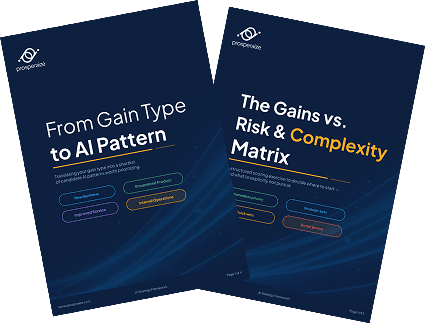
Two frameworks that take your team from business goal to one defensible AI use case - mapping gain types to validated patterns, then scoring candidates on value vs. complexity.
Get the download →