The Real Reason 90% of AI Initiatives Don't Become Profit-Generating Assets

AI assets demand a breadth of expertise that no single role, team, or department was ever designed to carry. Here's what actually goes wrong and why.
Read more →Access isn't the same as follow-through. Finding information is one problem. Getting the right person to act on it is another.


Monday morning, a VP of Operations gets a message from the CEO. A new customer service policy is approved. It needs to be live company-wide by Friday.
The decision is clear. The document is ready. The announcement could go out in minutes.
Then the real work starts. Which locations are affected? Which managers need to know? Who's actually working this week, and who's on leave? Are there regional exceptions? Which locations have already rolled it out, and where has it stalled?
By Friday, leadership thinks the policy is in place. The VP knows several locations are still running the old process. Nobody dropped the ball. The organization simply had to push one decision through hundreds of people, teams, and systems. That's where execution breaks down.
A small company coordinates through direct conversation. As a company grows, departments, procedures, and approval chains appear, necessary mechanisms for operating at scale. But each one adds distance between a decision and the person who has to act on it.
An executive sees a strategic priority; a regional manager sees a target; a team lead sees tasks. An employee sees one more request on top of the work already in front of them. The decision is the same. The operational reality is not. At every step, context gets translated again, and ownership, exceptions, and timing can quietly disappear.
Companies have spent decades building systems to capture and share information: email, knowledge bases, CRMs, ERPs, project tools, Slack, dashboards. Generative AI added another layer: fast search, summarization, content generation.
And still, information gets lost between systems, teams, and decisions. A policy sits in the knowledge base while an employee makes the wrong call. A dashboard shows a project running late while everyone waits for someone else to step in.
Access isn't the same as follow-through. Finding information is one problem. Getting the right person to act on it is another.
Someone has to identify the affected locations, check who's available, explain what the change means locally, coordinate training, track implementation, chase the stragglers, tell a normal delay apart from a serious one, and escalate when needed.
None of that shows up in the original decision. Without it, though, the decision never becomes real. This is the hidden coordination work happening in emails, meetings, spreadsheets, and reminders. It's invisible. And it's expensive.
Every team builds knowledge the rest of the company doesn't have. Sales knows what works with a specific client. Engineering knows how to prevent a recurring production issue. A regional office knows how to adapt policy to local conditions. The organization has all of it. The challenge is getting it where it's needed, when it's needed.
That's why silos are so persistent. They're a natural byproduct of specialization, not a failure of effort.
Companies already have the information they need. What they lack is a reliable way to move it through the organization and turn it into action.
A system like this could recognize when something needs attention, work out who needs to act, gather the relevant context, coordinate the next steps, and check whether the job was actually done.
That is where an execution layer comes in. AI agents may help power it, but the real value is in making sure decisions don't stop at the point where they are made.
It could spot a business event, understand what it means, figure out who needs to act, pull the relevant context, reach the right people, coordinate dependencies, verify the outcome, and escalate if nothing happens. It would connect CRM, ERP, HR systems, shift schedules, and knowledge bases, each of which holds part of the story, while the execution layer ties them together.
Creating a task is useful. Sending a notification is useful. Neither guarantees an outcome.
A real execution layer needs to know what happened, which process it affects, who owns the next step, what context they need, whether they're available, what "done" looks like, and, most importantly, what happens if no one acts.
A system that sends a reminder is helpful. One that knows when to escalate, when to find another owner, and when to pull in a manager operates on a different level entirely.
Without verification and escalation, AI is just another notification system. With them, it becomes part of how the organization actually runs.
The information exists in every case. The challenge is coordination.
Beyond "hours saved" or "tasks automated", a new question is emerging: how fast can an organization turn a decision into coordinated action?
A shorter decision-to-action cycle means faster customer response, more operational resilience, and less manual chasing. The question shifts from "what can AI do for an employee" to "what can AI coordinate across an organization."
The model itself won't be the differentiator. Models are becoming commodities. The real advantage comes from what's built around them: process knowledge, organizational relationships, ownership, escalation logic, exceptions.
Over time, the system learns exactly where coordination tends to break in that specific company, and that knowledge compounds. It's not easy to copy, which is exactly what makes it an advantage.
Today, the VP of Operations spends part of her week finding out what happened after decisions were made. Instead of piecing together what happened through dashboards, meetings, and status updates, the VP could see who acted, what changed, and where execution stalled.
Fewer forgotten commitments. Fewer status meetings. Less manual chasing. More time for the things people actually do best: judgment, expertise, and working with customers.
But organizational friction sometimes protects people too. A system that can see schedules, tasks, communication, and performance in real time carries real coordination power, and that power needs clear boundaries. In high-stakes situations, people should keep control of the decisions; AI can coordinate, explain, verify, and escalate, while accountability stays with humans.
Technology determines what organizations can coordinate. Leadership determines what they choose to coordinate. That might be the most important question of all.
The real test for enterprise AI is simple: does a decision lead to action?
Dušan Stamenković is the founder of Prosperaize, an AI Asset Management Consultancy. He advises organizations on whether, where, and how to invest in AI — reducing risk and maximizing return across the AI investment lifecycle.
AI assets demand a breadth of expertise that no single role, team, or department was ever designed to carry. Here's what actually goes wrong and why.
Read more →
Most AI investment failures are decided in the first two weeks. This is how you ensure those two weeks are used wisely.
Read more →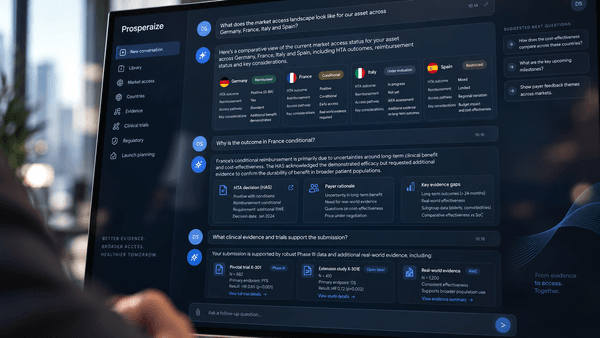
How a live AI system on a pharmaceutical market access platform was rebuilt on its own knowledge foundation, and single answers became a working dialogue with the data.
Read more →The question is whether anyone in the room can speak all the languages it demands, and what happens to your investment when they can't.
If you want to know where your AI investment is actually exposed, let's talk.
Get in touch